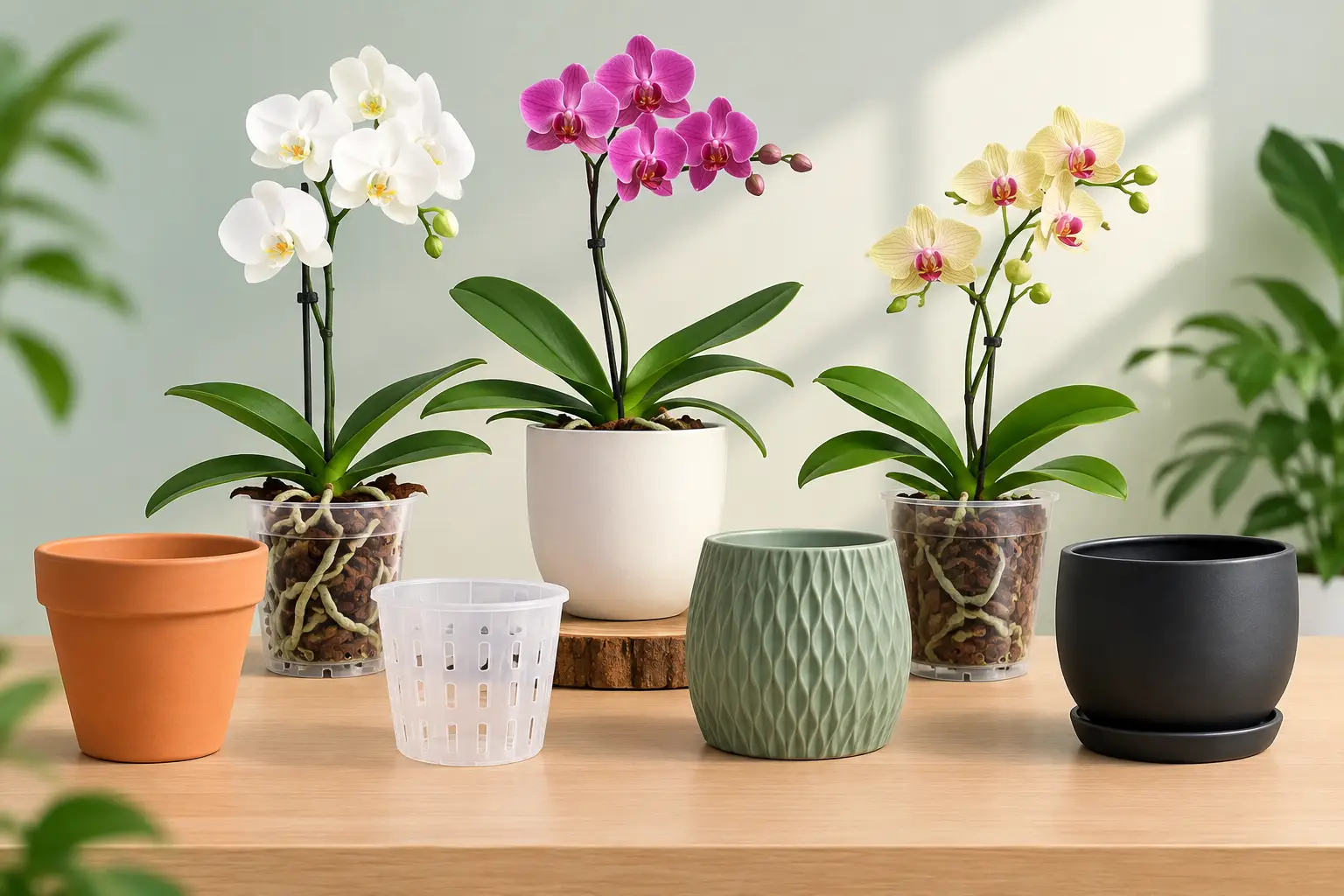
A gorgeous orchid can look perfectly at home in a hand-finished ceramic planter, but the answer to which pots suit orchids is not simply “the prettiest one.” Orchids have roots with opinions. Many common houseplant orchids grow on tree branches in nature, where rain drains quickly and air moves freely around every root. Give those roots a decorative pot with nowhere for water to escape, and even a beautiful bloom can soon become a rescue project.
The good news is that practical orchid care and expressive pottery belong together. Once you understand what your particular orchid needs, you can choose a pot that supports healthy roots while adding a little handmade character to a windowsill, shelf, or plant table.
Which Pots Suit Orchids Best?
For most orchids kept indoors, the best pot has drainage holes, fits the root system closely, and matches the plant’s need for air and moisture. Phalaenopsis orchids, the familiar moth orchids sold in bloom at grocery stores and nurseries, usually do well in a clear plastic grower’s pot with generous drainage set inside a decorative ceramic cachepot.
That two-pot arrangement is not a shortcut. It is often the most flexible choice. The clear inner pot lets you check the roots and see when the bark mix has dried, while the outer ceramic pot brings color, texture, and personality to the display. After watering, let the inner pot drain completely before returning it to its decorative home. Water should never remain pooled in the bottom of the outer pot.
A ceramic orchid pot with drainage holes can also be an excellent permanent home, particularly for orchids that appreciate a little more stability. Clay and ceramic add welcome weight around top-heavy plants with long flower spikes. Handmade pottery can turn an ordinary plant corner into something more personal – a small, useful work of art that happens to hold an orchid.
Start With the Orchid, Not the Pot
“Orchid” describes a huge family of plants, not one set of watering rules. Pot choice depends on whether your orchid likes its roots airy and quick-drying or slightly more evenly moist.
Phalaenopsis orchids generally prefer an airy bark-based mix and a pot that dries at a moderate pace. Clear plastic nursery pots, especially those with side slots or plenty of holes, work beautifully because they allow close root inspection. Their roots often turn silvery when dry and greener after watering, making timing easier to read.
Cattleyas, dendrobiums, and oncidiums often enjoy substantial airflow around their roots as well. Slotted plastic pots, net pots, or clay orchid pots with extra side openings can be useful for these types. The trade-off is faster drying. In a bright Texas home, or near a sunny window with air conditioning, that may mean watering more often.
Paphiopedilums, sometimes called lady’s slipper orchids, tend to prefer more consistent moisture than many epiphytic orchids. They still need drainage, but a pot that holds moisture a little longer can be helpful. A glazed ceramic pot with a drainage hole may suit them well, as long as the potting medium is appropriate and never stays soggy.
Terrestrial orchids are another story. They grow in soil-like media rather than clinging to branches, so their pot needs may look closer to those of other houseplants. Always identify the orchid before choosing a permanent container. A pot that is wonderful for a cattleya may be far too airy for a moisture-loving slipper orchid.
Drainage Is the Non-Negotiable Detail
If you remember one thing while shopping for an orchid pot, let it be this: a drainage hole matters more than almost any decorative feature. Orchid roots need moisture, but they also need oxygen. Standing water pushes air out of the potting mix and creates conditions where roots can rot.
A pot with one generous drainage hole can work for many orchids. Several holes are even better when the plant is in a dense bark mix or when watering habits tend toward generous. Specialty orchid pots may have slits, openings, or holes along the sides, which increase airflow and speed drying.
A planter without a drainage hole is best used as a cachepot, not as the pot where the orchid is directly planted. Keep the orchid in its inner nursery pot, place it inside the decorative vessel, then remove it for watering. Let it drain in a sink or on a tray until water no longer runs freely from the bottom.
That small ritual protects both the orchid and the ceramic piece. It also makes it easier to change the plant’s look for a season, a new room, or a special gathering without disturbing the roots.
Ceramic, Plastic, and Clay: What Changes?
Pot material affects how quickly the medium dries, how much the plant weighs, and how easily you can monitor the roots. There is no single winner. The right material depends on your plant, your home, and how you prefer to care for it.
Clear plastic is especially useful for beginners growing phalaenopsis orchids. It is lightweight, inexpensive, and reveals what is happening below the surface. Healthy roots are easier to spot, as are crowded roots, decaying bark, and moisture lingering too long. Its practical appearance is precisely why it pairs so nicely with an artful outer planter.
Unglazed terracotta is porous. Moisture moves through its walls, helping orchid mixes dry more quickly and allowing some air exchange. This can be a gift to orchids prone to rot, but it can be demanding in dry rooms or hot climates. Terracotta also gathers mineral deposits over time, which some gardeners find charming and others prefer to scrub away.
Glazed ceramic is less porous, so it holds moisture longer than terracotta. It is also heavier, more stable, and available in an endless range of colors and shapes. A hand-finished ceramic pot can make a blooming orchid feel less like a temporary grocery-store plant and more like part of the room’s collected story. Just be realistic about watering: glazed ceramic requires a watchful hand, proper drainage, and a potting mix suited to the orchid.
Pot Size: Small Is Often Kinder
Orchids usually prefer a pot that feels a little snug. An oversized container holds extra growing medium, and that unused medium stays wet long after the roots have taken what they need. More space may sound generous, but for an orchid it can mean slow drying and root trouble.
When repotting, choose a container only about one inch wider than the existing root mass in most cases. If the old pot has become crowded but the roots are healthy, that modest step up is enough. A mature phalaenopsis may remain happy in the same size pot for years if the old medium is replaced and damaged roots are trimmed away.
The exception is an orchid with vigorous new growth that clearly needs room, or one whose roots have pushed the plant out of its container. Even then, resist jumping several sizes. The goal is to make space for roots, not to bury them in wet bark.
Shape Matters More Than It Seems
Choose a pot that is broad and stable enough to balance leaves and flower spikes. Orchids can become surprisingly top-heavy while blooming, especially when a plant has two long stems of flowers. A low, wide ceramic cachepot gives visual and physical balance, while a narrow vessel may tip when the blooms lean toward the window.
Avoid containers with a very tight neck if you plan to plant directly in them. Orchids eventually need repotting, and tangled roots do not enjoy being pulled through a small opening. A gently tapered or straight-sided pot is much kinder at repotting time.
For a display planter, make sure there is a little breathing room around the inner plastic pot. If it fits so tightly that you cannot lift it out, watering becomes awkward. Leave enough space to remove the plant comfortably and to check that no water has collected below it.
When to Repot an Orchid Into a New Pot
Repotting is usually best after flowering, when the plant is ready to focus energy on roots and new leaves. Do not repot simply because the blooms have faded. Look for a potting mix that has broken down into fine particles, roots circling tightly through every opening, a plant that wobbles in its container, or roots that stay wet far too long.
Gently remove old medium, rinse away loose bits if needed, and use clean snips to remove roots that are soft, hollow, black, or papery. Firm green or silvery roots are worth protecting. Set the orchid so its crown, where leaves meet, remains above the medium. Burying the crown can invite rot.
Fresh orchid bark is not ordinary potting soil. It is designed to create pockets of air around the roots. Press it into place lightly enough to steady the plant, but do not pack it down like soil around a patio flower.
Let the Pot Be Part of the Pleasure
An orchid does not need a plain home to grow well. A soft sea-glass glaze, a leaf-inspired dish beneath the pot, or a small handmade planter with a playful woodland detail can bring warmth to the ritual of plant care. The practical pieces still matter: drainage, size, airflow, and a good growing medium. But once those needs are met, there is room for a little wonder on the windowsill.
About the Artist
Billy Williams is the artist behind Billy’s Creations TX, where he creates handcrafted ceramics, bonsai pots, wildlife photography, and other original artwork. Visit Billy’s Creations TX on Etsy to browse available pieces and see more of his work.
Choose a pot that lets your orchid’s roots breathe, then choose the handmade color, glaze, and character that makes you smile each time new buds begin to open.